In the fast-paced world of online advertising, banners play a key role in attracting the attention of Internet users and promoting products, services, and ideas. Today we will look at the main formats of advertising banners – HTML5 and GIF – and determine which one to choose for the optimal result in your advertising activity.
HTML5 banners are a dynamic type of digital advertising created using the HTML5 hypertext markup language. This coding language is extremely convenient for creating online advertising because it has wide support in all web browsers. HTML5 banners are similar to mini web pages that are interactive with interesting and complex animations, and they are also easy to integrate into any website. For this, an iframe is used – a special HTML tag that allows you to add an HTML5 banner or other content to a web page. It allows you to preserve the page structure and interact with this embedded content separately.
*example of a BannerBoo HTML5 template from the "Fashion" category
HTML5 banners are quite popular among advertisers, as they offer a lot of space for creativity and imagination. Among the main advantages are:
HTML5 banners invite users to participate. Click here, swipe there – it's not just an advertisement; it's an engaging experience.
HTML5 banners impress with the variety and complexity of animation. You can implement your ideas without any restrictions and captivate the audience with dynamic and interesting visuals.
One of the outstanding features of HTML5 banners is that they perfectly adapt to any device. They will look equally attractive on a PC monitor and on smartphone screens. This is very important, especially now when users are constantly switching between devices.
HTML5 banners are distinguished by their ability to easily integrate various multimedia elements, which expands the possibilities of transmitting your message and encourages users to learn more about the product and click on the banner.
buttons: HTML5 allows you to easily add interactive buttons that can interact with the user, for example, by directing them to your website or form.
animated objects: thanks to HTML5, you can insert animated graphic objects that create visual effects that impress and attract the attention of the audience.
video: HTML5 allows seamless embedding of video directly into the banner. This can be useful for conveying short and informative visual content.
sliders: integrating sliders into HTML5 banners provides the ability to show multiple images or messages in a convenient format, ensuring the ability to convey more information in a limited space.
HTML5 advertising banners offer a wide color palette (approximately 16.7 million shades). This allows you to create banners that have high quality and saturated colors.
HTML5 banners can be easily edited and updated even after publication without the need for re-uploading. Regardless of whether it's about setting up ad offers, updating product information, or adding new effects, HTML5 banners allow content to be edited, which means that the ad message will remain relevant throughout the entire ad campaign.
*example of a BannerBoo HTML5 template from the "Valentine's Day" category
Thus, HTML5 banners combine responsive design and the magic of multimedia, ensuring that your message will not only be displayed correctly on all types of devices, but will also impress the audience with its unique visuals and encourage interaction.
Although HTML5 banners have many advantages, it is still worth noting the weaknesses of this format.
Although HTML5 is a web development standard and has received wide support, different browsers can interpret its elements differently. This can lead to the banner displaying differently on different platforms. It is important to test and check compatibility with different browsers to ensure optimal appearance and functionality of your HTML5 content for all users.
Often, creating an HTML5 banner requires an experienced developer. The complexity of the process can be an obstacle, especially for those who have limited programming skills and understanding of the intricacies of web technologies.
But even if you are not a professional developer or designer, there is a solution that makes creating HTML5 banners easy and accessible. BannerBoo is an online banner editor that allows you to create both static and animated banners in various formats.
Its simple interface makes the banner creation process easy even for those who have no experience in design or programming. You can create a banner from scratch, or choose one of the many templates and modify it for your needs. After the banner is ready, you just need to choose the desired format to download it to your computer. In this case, the HTML5 format. Thus, BannerBoo becomes an effective tool for those who are looking for a simple and quick way to create exciting HTML5 banners.
Don't let the difficulties of developing HTML5 banners scare you. Now that you are familiar with all the subtleties and pitfalls, you will be able to quickly and effectively avoid any problems associated with this process.
GIF (Graphics Interchange Format) has existed almost since the beginning of the Internet. In fact, it is a looped animation that consists of a series of images. In addition to graphics, GIF banners can also contain a little text. Almost everyone is familiar with this format, as it has gained significant popularity over the past ten years. Usually, these images are entertaining and are widely used for sharing in messengers between friends. In addition, the GIF format is not only used to create fun content but also becomes an effective tool in the field of advertising. Its ability to play animation and attract the attention of users makes GIF banners a popular choice for creating creative and concise advertising messages.
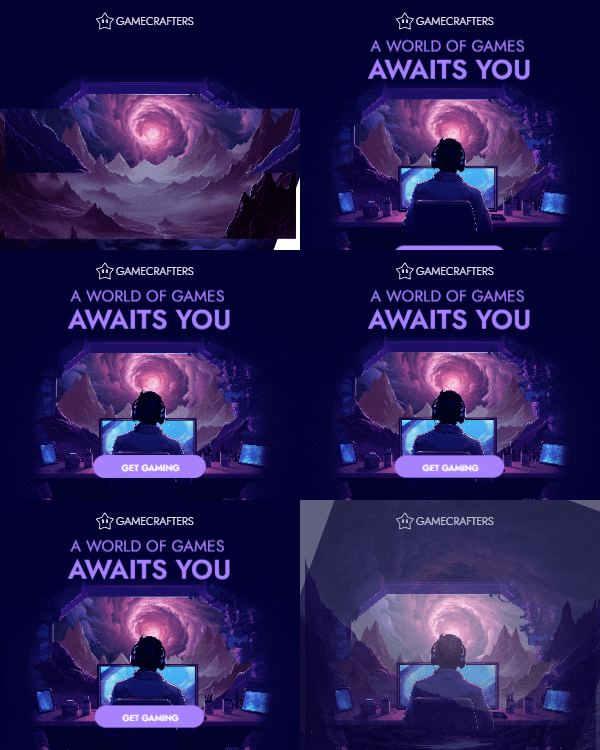
*example of a BannerBoo GIF template from the "Games" category
Let's look at the advantages of the GIF format in more detail:
One of the significant advantages of the GIF format is its ease of creation. You don't have to be a highly qualified graphic designer to create an attractive and effective GIF banner. It is enough to have only desire and a little creativity. GIF creation interfaces are usually intuitive and allow you to effectively experiment with animation and text.
Thanks to their simplicity and wide support, GIF banners can be placed on almost any platform. GIF files become a universal language that plays without problems on all devices. This means that your message will reach every user without compatibility problems.

*example of a BannerBoo GIF template from the "Travel" category
So, if you like simplicity, speed of creation, and reaching a diverse audience, GIF banners can be an excellent choice for your marketing activity.
Let's analyze the key limitations of the GIF format:
GIF files can only display 256 colors. And while this may be enough to create some messages, if your advertisement requires the demonstration of bright and detailed images, this can become a serious problem.
One of the disadvantages of the GIF format is the lack of interactivity. Compared to other formats, such as HTML5, GIF does not provide opportunities for creating complex interactive elements or animations that react to user actions. This can limit your ability to interact with the audience.
One of the disadvantages of the GIF format is that each frame in the video sequence is rendered repeatedly. This can lead to a significant increase in file size, especially when many frames are used.
But fear not! Understanding these limitations allows for strategic use of GIF files, ensuring their effectiveness. Remember, proper consideration of these aspects will help maximize the impact of your content.
While the HTML5 format has a color palette that includes approximately 16.7 million shades, GIF can only display 256 colors. In addition, HTML5 banners can be made responsive, which ensures correct display on any device, while GIF files remain unchanged. Thus, it can be concluded that for achieving a high-quality and attractive design, choosing the HTML5 format turns out to be more promising.
HTML5 advertising banners are created using HTML, CSS, and JavaScript, which provides more complex animation compared to GIF files. In addition, HTML5 banners have wide possibilities for adding various interactive elements.
On the other hand, GIF banners convey an informal and friendly atmosphere. Although they may not have the same dynamic range as HTML5, their simplicity ensures seamless and reliable operation on all devices.
In terms of file size, HTML5 advertising banners usually have a smaller size and are more efficient than their GIF counterparts. This is an important advantage, especially now when many advertising platforms have a file size limit of 150kb.
Usually, to create an HTML5 banner, you need not only design skills but also the ability to work with code. At the same time, everyone can create a GIF banner, because the interface for creating banners is usually simple and intuitive.
However, if you create your banner using the BannerBoo service, this difference is leveled, because regardless of the chosen format, it allows you to create a banner easily and quickly. All you need is to choose the desired format before downloading it to your computer.
*example of a BannerBoo HTML5 template from the "Real Estate" category
Thus, it can be noted that the HTML5 format turns out to be a more universal choice for advertisers. However, in some cases, a GIF banner can also be an excellent choice for transmitting an advertising message.
Okay, we've dealt with the technical data, but how do we figure out when each format is best suited for use? It's simple.
HTML5 banners should be used when you need interactivity, flexibility, and deeper user engagement.
Choose HTML5 if:
HTML5 allows for creating more "lively" creatives, which often result in a higher CTR.
When is HTML5 not the best solution? For example, if:
When is it better to use GIF?
GIF banners work well if:
This is a simple, basic, but reliable format for most tasks.
Banner size greatly affects download speed, user experience, and overall ad effectiveness.
HTML5 banners:
GIF banners:
So, HTML5 is better suited for complex creatives, GIF - for simple ones.
Compatibility is one of the key differences between HTML5 and GIF.
GIF
HTML5
HTML5 offers more possibilities, but requires more knowledge and technical preparation.
When using HTML5 banners, it is important to consider platform rules.
File requirements
Account requirements (HTML5 is not available to all accounts)
Required:
Animation:
You must use a special clickTag variable to track clicks, which opens the link in a new window. This is the basic minimum for launching ads.
HTML5 banners – it's about interactivity, dynamics, and user engagement. They work best where it's important not just to show the product, but to hold attention.
Where to use?
1. eCommerce (product carousels)
The user can scroll through products directly in the banner – like a mini-catalog.
For example: an online store shows 5 products with different variations.
2. Interactive campaigns
The banner reacts to actions: hovering, clicks, selecting options.
For example: Choose your style → the product in the banner changes.
3. Mobile playable ads
A mini-game directly in the ad (especially for IT).
Allows the user to experience the product before installing it.
4. Product demonstration
Step-by-step display of functions or advantages.
For example: how an app or gadget works.
HTML5 is best suited for businesses when you need to engage, retain, and show more than one message.
GIF banners – it's about speed, lightness, and mass appeal. They are not overloaded and work as a reminder.
Where to use?
1. Promotions and discounts
Flashing or changing messages like "-30%", "only today". Clear and to the point.
2. Retargeting
Reminders about a viewed product or cart. Minimum information and maximum effect.
3. Simple ads
When you need to quickly convey one message. For example: launching a new collection.
4. Quick testing (A/B)
Easy to create and scale variations. Ideal for testing hypotheses.
GIF is most effective when it is important to quickly, cheaply, and massively test or remind about a product or service.
Now that we've explored the strengths and limitations of HTML5 and GIF banners, it's time to choose the ideal option for your online activity.
First on our checklist is the goal of your campaign. What is the main message you want to convey? If your goal is to tell a captivating story with complex details and interactive elements, HTML5 will help you best. On the other hand, if your priorities are simplicity and quick engagement, GIF banners will do an excellent job.
Next, let's think about your target audience. Imagine your ideal viewer – are they tech-savvy people exploring the latest gadgets, or perhaps a broader audience looking for simple and interesting content? HTML5 banners, with their multimedia and visual richness, can resonate well with a more experienced audience. At the same time, GIF banners, with their lightness and unobtrusiveness, can attract the attention of a wide audience.
Now let's talk about the message you want to convey to users. If your campaign is aimed at creating an immersive effect, or a detailed demonstration of product features, HTML5 will help convey more information using interactive elements, including the ability to add video inside the banner.
On the other hand, if your message is concise and playful, GIF banners can create a light and friendly atmosphere.
*example of a BannerBoo HTML5 template from the "Pets" category
Remember, the right banner is not just a visual; it's a strategic choice that aligns with your campaign goals, the type of product you're promoting, and your target audience. So, before you click "launch," consider all these components, as well as the message you want to convey. All of this will help attract and engage potential buyers.
Ultimately, there is no one-size-fits-all solution. Each banner format has its unique strengths and limitations. Therefore, make your choice according to the specific needs of your campaign. Let your goals and audience be the compass that guides you to the ideal banner. Remember: the success of your digital campaign depends not only on pixels and animation but also on the strategic combination of creativity and purpose.
HTML5 has several advantages over GIF in advertising:
interactivity;
complex animation;
responsive design;
easy integration of multimedia elements;
bright and high-quality images;
simple editing at any stage.
In summary, HTML5 provides more flexibility, opportunities for interaction, and the creation of a more enhanced visual experience compared to GIF in an advertising context.
The choice between HTML5 and GIF in advertising campaigns depends on the specific goals and needs of the campaign. Here are some use cases for each format:
HTML5:
interactive advertising campaigns: HTML5 is ideal for campaigns that require interactive elements, such as embedded forms, games, animations, and more.
multimedia messages: if your campaign involves the use of video, audio, and other multimedia elements, HTML5 will provide more opportunities for their integration.
responsive design: when it is important that the advertisement looks correct on different devices and screen sizes, HTML5 allows you to create responsive content.
GIF:
simple animations: GIF is often used for small, simple animations that do not require a large number of frames.
concise images: if your campaign is aimed at effectively conveying a message using static or minimally animated images, GIF can be an effective choice.
HTML5 responsiveness is a key advantage in advertising campaigns, as it allows content to be displayed correctly on different devices. The main impacts of HTML5 responsiveness on correct display include:
different screen sizes: HTML5 allows you to create flexible layouts and adapt them to different screen sizes, which allows you to effectively adapt advertising content to smartphones, tablets, and desktop computers.
screen orientation: HTML5 can react to changes in screen orientation, ensuring correct display regardless of whether the user has a vertical or horizontal orientation.
retina displays: thanks to the use of vector graphics and high-quality images, HTML5 provides high-quality display on high-pixel density screens (retina displays).
technical characteristics of devices: HTML5 responsiveness takes into account the technical characteristics of devices, such as Internet connection speed and computing capabilities, ensuring optimal content playback.
In summary, HTML5 responsiveness makes it an ideal choice for advertising campaigns where it is necessary to ensure optimal display on different devices and in different usage conditions.
Yes, GIF can compete with HTML5 in certain advertising scenarios, and both formats have their advantages and limitations. Here are some scenarios where GIF can be competitive:
simplicity and low demandingness: if the main emphasis of the advertising campaign is on simplicity and ease of use, GIF can be a convenient choice. It does not require specialized skills to create, and it can be easily added to various platforms.
popularity: GIF has become a popular image format for entertainment and communication online. If you want to use this notoriety to create memorable content, GIF can be an effective tool.
quick messages: in cases where you want to convey a short message or animation without significant technical costs, GIF can be an effective choice.
However, for complex animations, a large number of frames, or the use of multimedia elements, HTML5 can provide more possibilities and flexibility. The choice between GIF and HTML5 will depend on the specific needs of the advertising campaign.