Banner advertising is one of the oldest and most effective formats of digital advertising. For decades, it has been helping companies capture user attention, increase brand awareness, and attract new customers. Despite the emergence of social networks, content marketing, and video advertising, banners remain an important digital marketing tool, allowing advertisers to scale their campaigns, effectively convey messages, and engage with the audience at various stages of the sales funnel.
It all started back in 1994, when the first advertising banner appeared on the Internet. Back then, it caused a real sensation, achieving a fantastic click-through rate of 44%. Today, the numbers are no longer so impressive, as internet users have become more demanding, and the advertising market has grown more complex. However, banners have evolved along with technology. From static images, they have transformed into animated banners, interactive HTML5 ads, and even video ads running inside banner frames.
Along with this, the approach to targeting has also changed. While advertising used to be shown to everyone indiscriminately, today algorithms analyze user behavior, interests, and actions to display the exact ad that has the highest chance of capturing their interest. With growing competition, the phenomenon of "banner blindness" emerged—users have learned to simply ignore ads. This has forced advertisers to seek new approaches: creative formats, interactivity, and personalization.
The world of banner advertising has become vast and diverse, and today there are numerous types and formats of banners. Each has its own features, characteristics, and advantages, and to get the maximum return on banner advertising, it is essential to understand them all.

* The first banner ad on the Internet
Over the past decades, banner advertising has changed significantly. While the first banner ad in Internet history had a CTR of about 44%, today, due to high competition, banner blindness, and the growing volume of advertising, average click-through rates are much lower. At the same time, modern technologies—personalization, artificial intelligence, interactivity, and dynamic creative optimization—help compensate for this and increase the effectiveness of advertising campaigns.
It is worth remembering that CTR (Click-Through Rate) depends on many factors: the advertising platform, target audience, creative quality, targeting settings, industry, and ad placement. Therefore, the figures below are average benchmarks that help compare the performance of different banner ad types and understand which formats drive the best user interaction today.
More and more advertisers also evaluate not only CTR but also Engagement Rate, Hover Rate, Interaction Rate, Viewability, and other metrics that allow for a comprehensive evaluation of modern banner advertising. This is why interactive, Rich Media, and Shoppable banners often show better results, even if their CTR does not differ significantly.
Estimated indicators:
| Banner ad type | Estimated CTR |
|---|---|
| Static Banner Ads | 0.05–0.10% |
| Animated Banner Ads (GIF / HTML5) | 0.10–0.25% |
| Video Banner Ads | 0.30–0.80% |
| In-banner Video Ads | 0.50–1.20% |
| Rich Media Banner Ads | 0.30–0.90% |
| Interactive Banner Ads | 0.40–1.20% |
| Expandable Banner Ads | 0.40–1.00% |
| Gamified Banner Ads | 0.80–2.00% |
| Playable Banner Ads | 1.50–5.00% |
| AI-generated Banner Ads* | 0.15–0.60% |
| Shoppable Banner Ads | 0.80–2.00% |
| Web Banner Ads | 0.05–0.20% |
| Social Media Banner Ads | 0.50–1.50% |
| Email Banner Ads | 1.50–4.00%* |
| In-App Banner Ads | 0.30–0.80% |
| Responsive Banner Ads | 0.20–0.60% |
| Adaptive Banner Ads | 0.20–0.60% |
| Dynamic Banner Ads | 0.50–1.50% |
| Contextual Banner Ads | 0.30–0.90% |
At the same time, modern advertising platforms increasingly evaluate not only CTR but also Engagement Rate, Hover Rate, Interaction Rate, and Viewability, which better demonstrate the effectiveness of the creative.
| Banner type | Average Engagement Rate |
|---|---|
| Static | <1% |
| Animated | 1–3% |
| Rich Media | 5–15% |
| Interactive | 8–20% |
| Gamified | 15–35% |
| Playable | 20–40% |
| Shoppable | 8–18% |
| In-banner Video | 5–12% |
Modern banner advertising is no longer just a struggle for clicks, but also for user attention and interaction. That is why when choosing a format, one should focus not only on CTR but also on how effectively the banner engages the audience and helps achieve the advertising campaign's goals.
Display banner ads (or display banner advertisements) are digital ads that typically look like a graphic block and can contain images, animation, text, video, and even interactive elements. Such ads are often seen on websites, in mobile apps, or on social media platforms.
They can come in various sizes, types, and formats, and are mostly used for promotional purposes. However, besides commercial advertising, they can perform other functions, such as informational or educational. The main task of a banner ad is to capture the user's attention, spark interest, and motivate them to take a specific action: visit a website, register, download an app, make a purchase, and so on.
Today, an effective banner ad is not just a nice picture, but a well-thought-out mechanism that, when set up correctly, can significantly influence user behavior.
"Banner ads are like road signs, but on the Internet.
They unobtrusively (or otherwise) guide users in the right direction."
Banner ads can be classified according to the following criteria:
By content format, banner ads are divided into:
By interactivity and engagement, banner ads are divided into:
By placement environment, banner ads are divided into:
By adaptability to different conditions, the following are distinguished:
Let's look at each of these types.
The banner ad content format determines the way the advertising message is presented and plays a key role in capturing the audience's attention. Depending on the chosen format, ads can be simple and unobtrusive, or interactive and engaging.
By content format, banner ads are divided into static (Static Banner Ads), animated (Animated Banner Ads), video (Video Banner Ads), and Rich Media (Rich Media Banner Ads). A simple static banner is a basic option that loads quickly and does not require complex technologies. Animated banners capture more attention through motion, while video banners allow a brand's key message to be conveyed in a dynamic format. The most complex ones are Rich Media, which contain interactive elements, allowing users to interact with the content even before clicking.
Understanding the difference between them helps in choosing the right type of banner ad for a specific marketing campaign. Whether you need to create a simple ad for quick brand recognition or engage users with dynamic video or interactive content determines the effectiveness of the advertisement and its impact on the audience.
Static Banner Ads are banners that contain images and text but remain stationary. They are the simplest and most traditional type of banner advertising, used for quickly delivering an advertising message to the audience. Unlike other types, static banner ads rely on striking design and a concise message.
Their main advantage is simplicity and versatility. They load quickly, are supported by all platforms, and have no playback limitations.
This type of ad is an excellent option for brands that want to deliver an advertising message quickly and effectively without needing complex technologies. They perform well in display networks, social media, email newsletters, and on websites, providing stable results with minimal technical requirements.

* based on the example of a BannerBoo template from the "Retail" category
Animated Banner Ads are banners that contain animation, which can range from simple frame-transition effects to complex moving elements. They make advertising more dynamic and capture user attention much better than static banners.
The main advantage of animated banners over static ones is that they can convey more information by using multiple scenes or changing elements. This is especially useful for demonstrating a product, special offers, or step-by-step explanations of benefits. While a standard static banner must fit the entire message into a still image, an animated banner allows the essence of the promotional message to unfold gradually.
Animated banners are a powerful digital advertising tool that combines dynamics, creativity, and effectiveness. They perform particularly well in display networks, social media, and mobile apps, and are frequently used to increase click-through rates and capture audience attention.
* based on the example of a BannerBoo template from the "Business" category
Video Banner Ads are banners that use video as the primary visual element. They combine the advantages of traditional banner advertising with the visual appeal of video content, allowing brands to effectively convey emotions, demonstrate a product in action, and tell a brand story.
The main advantage of video banners is their ability to capture and hold attention longer than static or animated banners. Moving content naturally draws the eye, and combining it with audio makes the advertisement even more effective. However, they can slow down website loading times, which may negatively impact the user experience. Additionally, not all platforms support auto-play, meaning the video may not always be noticeable from the very first frame.
Video banners help brands create vivid and memorable advertising campaigns. They work effectively in programmatic advertising, social networks, and display networks, offering more opportunities for a creative approach and audience engagement.
* based on the example of a BannerBoo template from the "Construction and Repair" category
Rich Media Banner Ads are banners that contain interactive elements, animation, audio, video, or other dynamic effects, allowing users to interact with the ad without needing to navigate to another website. They offer significantly more opportunities for audience engagement than static or even animated banners.
The main advantage of Rich Media ads as a whole lies in their flexibility and functionality. Such ads can feature control elements, 3D graphics, game mechanics, contact collection forms, or even miniature web pages inside the ad itself. Thanks to this, users can interact with the brand before clicking, which increases the likelihood of engagement and conversion.
Rich Media creatives are typically built using HTML5 technology. This provides flexibility in design, responsiveness across different devices, and integration with analytics tools to track user interactions. At the same time, it requires more resources to create. They can also consume more traffic, which might affect page loading speed, particularly on mobile devices.
Due to their ability to engage users and create a deeper advertising experience, Rich Media banners are frequently used in premium display ad campaigns, programmatic advertising, and by brands striving to make an unforgettable impression and maximize interaction with their audience.
* based on the example of a BannerBoo template from the "Business" category
Rich Media Banner Ads remain one of the most effective digital advertising formats, but in 2025–2026, their capabilities have expanded significantly.
Modern Rich Media banners have long moved beyond simple animations or videos. They can feature interactive product galleries, carousels, product configurators, quizzes, calculators, mini-games, social media integration, maps, lead generation forms, and even augmented reality (AR) elements.
Unlike standard banners, Rich Media allows users to interact with the ad without leaving the publisher's website. A person can browse a product catalog, select a product color, swipe through photos, or watch a video right inside the ad unit.
This significantly increases the average interaction time with the ad, positively impacting brand awareness and the quality of the advertising campaign.
This is why Rich Media is actively used by major brands, automotive companies, banks, travel services, and online stores where showcasing the product in maximum detail is crucial before the user proceeds to the website.
One of the key aspects of banner advertising effectiveness is its ability to engage users and encourage interaction. It is the level of interactivity that determines how the audience perceives the ad: passively or actively. Some banner ads perform only an informational function, requiring no action from the user, while others are designed to capture attention through animation, interactive elements, or game mechanics.
This division is particularly important when choosing an ad format, as interactive ads can significantly boost engagement but also require more thorough development.
Non-Interactive Banner Ads are banners that do not involve any user interaction other than clicking on them. They can be static or animated, but their core format remains simple: the banner displays the advertising message without additional interactive elements.
The main advantage of such banners lies in their high compatibility with ad networks and websites, making them a versatile solution for campaigns focused on reaching a broad audience. The absence of complex interactive components ensures fast banner loading and stable display across all devices.
Another benefit is cost-efficiency. Since these banners do not require complex development, they are more affordable compared to interactive ones.
Even though interactive ad types are gaining popularity, classic (non-interactive) banners remain an effective tool for building awareness, promoting sales, and special offers, especially when combined with creative design and well-conceived advertising messages.

* based on the example of a BannerBoo template from the "Christmas" category
Interactive Banner Ads are banners containing interactive elements that allow users to engage with the ad. This can be something simple, like an image changing on hover, or more complex mechanics, such as embedded forms, mini-games, videos, product configurators, or even 3D animations.
Their advantages are clear. First, higher engagement—users spend more time interacting with such banners, which increases the likelihood of conversion. Second, a better user experience, as ads can be not only informative but also entertaining or even useful. For example, they can allow users to change product colors, test product features, or play a mini-game.
Another key advantage is the ability to collect additional data. Thanks to interactive elements, user behavior can be analyzed: which buttons they click, which features they test, and how much time they spend interacting. This gives advertisers more opportunities to optimize campaigns.
Technically, such banner ads are usually built using HTML5, JavaScript, and CSS, and can be adapted for various platforms and devices. While this requires more resources and time, their effectiveness often justifies the investment.
Interactive banner ads are actively used in brand awareness campaigns, programmatic advertising, and for promoting mobile apps. They are especially effective for e-commerce, gaming, the automotive industry, and tech brands, where it is crucial not just to show a product but to let users experience it in action.
* based on the example of a BannerBoo template from the "Business" category
Interactive Banner Ads is a format whose popularity is growing rapidly due to the advancement of HTML5, JavaScript, and modern advertising platforms.
Unlike standard banners, interactive ads do not just display a promotional message; they involve the user in an interaction. This can include clicks, scrolling, hovering, switching slides, selecting products, answering questions, or even completing short games.
The longer a user interacts with the ad, the more likely they are to remember the brand and perform the target action. That is why modern advertising platforms increasingly evaluate not only CTR but also interaction metrics (Engagement Rate, Hover Rate, Interaction Rate).
In the face of growing competition for user attention, interactive ad types are a powerful tool for creating a unique advertising experience that not only attracts attention but also sparks interest and motivates action.
Among the variety of interactive banner ad types, Gamified Banner Ads and Playable Banner Ads stand out due to their unique interaction mechanics, while Expandable Banner Ads are among the most common.
Expandable Banner Ads are banners that can change their size when a user interacts with them. Initially, they look like a standard banner, but when a user hovers or clicks, the banner expands, occupying more screen space. The core concept of such banners is to attract more attention without being overly intrusive. In its standard compact form, the banner does not interfere with the user, but once expanded, it becomes a full ad unit with interactive capabilities.
Gamified Banner Ads use game mechanics to engage users. Unlike standard interactive banners, which might feature simple interaction elements (such as clicking a button or changing an image), gamified banners offer a full micro-gaming experience. They encourage the user to perform a specific action—spin a wheel of fortune, complete a mini-quest, collect points, or even take a quiz. Gamified banner ads are a great way to turn passive viewers into active participants in an advertising campaign, creating a unique user experience that drives interaction and boosts brand loyalty.
Playable Banner Ads allow users to test a product, typically a mobile app or game, directly within the ad unit. They offer a simplified demo version of the game or app functionality that can be tried before downloading. Unlike other interactive or even gamified banner ads, Playable Banner Ads come closest to the actual user experience of the product. They don't just drive user engagement; they let them feel what exactly they will get after interacting with the brand. This significantly improves lead quality and conversion likelihood.
Shoppable Banner Ads have become one of the most prominent digital advertising trends in recent years. Their main feature is that users can interact with products directly inside the banner. Unlike classic banners that only redirect users to a website, Shoppable Ads allow browsing products, changing options, viewing current prices, adding items to a cart, or proceeding straight to checkout.
This format significantly shortens the customer journey from viewing the ad to making a purchase, which positively impacts conversion rates.
Shoppable Banner Ads are particularly effective for:
Shoppable Banner Ads are particularly effective for:
Thanks to integration with product catalogs, these banners can automatically update prices, product availability, and promotional offers.
Interactive Rich Media Ads
In 2025–2026, the popularity of interactive Rich Media banners is growing the fastest.
They can contain:
Such ads significantly increase the user's interaction time with the advertisement and help brands stand out from standard banners.
Banner advertising covers a wide range of digital environments, and its effectiveness largely depends on choosing the right placement. Depending on where exactly users interact with banners, several main environments can be distinguished: banners on websites (Web Banner Ads), banners in mobile apps (In-App Banner Ads), in email newsletters (Email Banner Ads), and on social networks (Social Media Banner Ads).
Each environment has its own features, audience, and creative requirements, so banner ads that work in the web space may be less effective in mobile apps or social networks. At the same time, email banners help reinforce a text message, and mobile app ads organically fit into users' behavioral patterns.
The choice of environment for placing a banner ad determines its format, style, and even the way it interacts with the audience, making this aspect critical to a successful campaign.
Web Banner Ads (banner advertisements on websites) are banners placed on websites, representing one of the most common formats of digital advertising. They are also simply referred to as web banners. They can appear on various pages of online resources—from news portals and blogs to marketplaces and corporate sites, working as part of programmatic advertising or traditional display campaigns.
The main advantage of web banners is their flexibility, wide range of formats, and sizes. They can be static, animated, interactive, or even in video format. This allows advertisers to choose the optimal format depending on their goals and creative approach.
Their key difference from other banner ad types is that they operate in the open web. This means they can be seen on any website that participates in ad networks or sells ad space directly. Additionally, they support various targeting mechanisms, including contextual, behavioral, and geographic, allowing for precise ad delivery.
At the same time, their effectiveness depends on browser technologies, ad blockers, and responsiveness across different devices. For instance, they can be blocked by AdBlock or other filters, which affects their visibility; heavy or poorly optimized creatives can impact the user experience and reduce the likelihood of interaction.
Banner ads on websites remain an effective tool for driving traffic, increasing brand awareness, and supporting users at all stages of the marketing funnel. Their versatility and flexible setup options make them a key element of modern digital advertising.
Social Media Banner Ads are banners placed on social networks such as Facebook, Instagram, LinkedIn, X (Twitter), and TikTok. In a broad sense, they can be classified as Web Banner Ads because they also display in an online environment, but they possess unique characteristics.
The main difference between social media banners and website banners is their integration into the platform. Instead of appearing on third-party sites, they integrate organically into the news feed, stories, ad blocks, profile pages, carousels, and collections. This makes them less intrusive and increases the likelihood of interaction.
They also stand out favorably due to their targeting capabilities. Social networks collect massive amounts of user data, allowing advertisers to precisely target audiences based on demographics, interests, behavior, and other criteria. This enables the creation of personalized ad campaigns that often yield a higher click-through rate (CTR) and better conversion.
However, competition for user attention on social media is very high, so creatives must be bright, attractive, and clear to stand out in the feed. It is also necessary to regularly test different creative options, as social media algorithms change constantly, and ad effectiveness can drop quickly.
Social media banner ads are a powerful tool for increasing brand awareness, driving traffic, and boosting conversions. They are especially effective for campaigns aimed at user interaction and viral content sharing. Thanks to feed integration, precise targeting capabilities, and format diversity, they have become an integral part of modern digital advertising campaigns.
Email Banner Ads are banners placed inside emails, most often in promotional or informational newsletters. In a broad sense, they can also be categorized as Web Banner Ads, but due to their specifics, they are considered separately.
Their main difference from website banners is the delivery channel. Instead of appearing on third-party sites or in mobile apps, these banners land directly in the user's inbox alongside the email content. This allows advertisers to work with an already engaged audience, which increases the chances of interaction—especially if the email newsletter is targeted at brand subscribers or a customer database.
The absence of ad clutter typical of web advertising is another advantage of this banner ad type. Since users open the email themselves, attention to the content is generally higher than to website banners. Additionally, these banners often work in tandem with personalized offers, making them more relevant and effective.
However, there are certain challenges and limitations. For instance, a user might not see the banner due to image blocking in their email client or because they perceive promotional content as spam. Since most email clients do not support complex animations and scripts, banners do not support interactive HTML5 capabilities or the MP4 video format. Therefore, static formats (JPEG, PNG) or lightweight animated GIFs are most commonly used. Additionally, the file size must be optimized to avoid slow loading or default image blocking.
Banner ads in email newsletters are an effective tool for reinforcing email marketing, adding visual appeal to text messages. They work best when they are part of a well-planned strategy and are used in combination with personalized content.
In-App Banner Ads are banners integrated directly into a mobile app's interface and displayed during its use, allowing advertisers to reach mobile audiences in a specific environment.
They operate within a closed ecosystem, meaning they do not rely on browsers and can interact with users more effectively. They are often configured to blend seamlessly into the app interface, which improves the user experience and reduces the likelihood of the ad being ignored.
Another feature of theirs is the ability to integrate with mobile advertising platforms such as Google AdMob, Meta Audience Network, or Apple Search Ads. This allows targeting settings based on device type, location, behavioral data, and other parameters that help make the advertising more personalized.
At the same time, it is important to consider that an excessive number of ads in an app can negatively affect the user experience. It's also vital to keep in mind that mobile apps often utilize other ad formats, such as Rewarded Ads or Interstitial Ads, which can be more engaging.
In-app banner ads are an excellent choice for campaigns targeting mobile audiences. They perform well for monetizing free apps, advertising mobile games, other applications, e-commerce, and any brands aiming to interact with users directly within their favorite apps.
In-banner Video Ads are a modern variation of video advertising where the video clip plays directly inside a banner ad unit. Unlike classic Video Banner Ads, where video is the primary creative format, In-banner Video uses standard banner space on a page, automatically transforming it into a full video format.
Most of these ads start automatically without sound, and the sound is activated only after user interaction. This aligns with modern advertising platform requirements and ensures a comfortable user experience.
Key advantages:
This format is especially effective for launching new products, presenting automobiles, demonstrating software features, advertising mobile apps, and brand campaigns.
Imagine visiting your favorite website from your phone, and then opening it on your laptop. The banner ad you see changes: in one place it is compact and discrete, in another it expands to full screen, and sometimes it even adapts to your interests. This is not a coincidence, but the result of how modern advertising adapts to different display conditions.
Different approaches to banner ad adaptation allow brands to achieve maximum ad effectiveness. Some banners change their size and position depending on the device, while others adjust their content according to user behavior or page content. Thanks to this, the advertisement looks organic, attracts more attention, and increases the likelihood of interaction.
Let's look at the most common types of banner ads that adapt to changing conditions.
Responsive Banner Ads are banners that automatically resize, change their appearance, and format to fit any available ad space.
In general, Responsive Ads are one of the most flexible digital advertising formats. Instead of manually creating dozens of versions for different sizes, the advertiser uploads images, videos, adds headlines, descriptions, and a logo, and the advertising platform automatically combines these elements and selects the optimal option for each display location. This significantly reduces the time and cost of ad creation, which is especially beneficial for campaigns with broad reach.
Furthermore, thanks to artificial intelligence algorithms, the platform can test different combinations of images, texts, and calls to action, choosing which ones perform best. This not only saves time but also increases campaign effectiveness.
This type of ad is widely used in Google Ads. They are ideal for advertisers who want to maximize their reach and ad effectiveness without spending resources on creating separate formats.
Adaptive Banners are banners that dynamically adjust their sizes, ensuring perfect display on any device or screen without the need for custom code. They were developed by Google as an alternative to fixed-size banners to improve the user experience across different devices, particularly in mobile apps.
While Responsive Banner Ads exist, in his publication Spencer Johnson points out that they often produce ads that are too small. At the same time, adaptive banners always have the optimal size for the available ad space. Thanks to this, advertisers can be sure that their banner ad always looks correct, regardless of where the user sees it.
Dynamic Banner Ads are banners whose content automatically changes in real-time based on user data, behavior, interests, or external factors such as location or time of day.
Their main difference lies not in how they display on different devices, but in content personalization. While adaptive and responsive banners change size or structure, dynamic banners can alter text, images, call-to-action buttons, or other elements depending on who is viewing the ad. For example, if a user visited an online store website and browsed specific products, the banner can display those exact items with current prices and discounts. Or, if a person is in a specific city, the banner can show an ad for the nearest store with a relevant offer.
Such banners offer several key advantages. First, they increase personalization, which drives greater user interest and increases the likelihood of clicks. Second, they allow advertisers to save significant time and resources, as a single dynamic banner can replace dozens or even hundreds of static options. Third, they improve advertising campaign performance because they display the exact content that has the highest chance of conversion.
The use of dynamic banner ads is particularly relevant in e-commerce, financial services, the travel sector, retargeting campaigns, and any business dealing with a large number of products or services. They are perfect for campaigns where displaying current prices, product availability, or personalized offers is essential.
Contextual Banner Ads are banners that are automatically selected and displayed based on the content of the web page where they are placed. This means the ad is not random or generic but corresponds as closely as possible to what the user is looking for or reading at the moment of viewing. For example, if a person is reading an article about travel, banners advertising flights, hotels, or insurance services may appear on the page.
Here is how it works: the ad network's system scans the web page's content, determines its theme, and selects relevant ads. The selection of ads for display can take into account keywords, theme, language, and other factors.
When a banner appears in the context of what a person is already reading or searching for, the likelihood of them paying attention to it increases significantly. This approach improves the effectiveness of advertising campaigns, as users are shown only those advertisements that best match their interests or needs at the moment.
This type of advertising is particularly effective in content networks, on news sites, blogs, forums, or when reading themed articles. Thanks to its relevance, banners help create a positive user experience, which in turn can lead to greater loyalty and interaction with the brand.
Banner ad formats are standard dimensions of ad creatives used in digital advertising. They define not only the size of the banner but also how and where it will be displayed. This is similar to paper formats where, say, an A4 or A3 sheet has clear proportions, simplifying printing and document management. In the advertising world, standard banner sizes ensure a unified playing field for designers, marketers, and advertising platforms. Thanks to this, brands can create versatile creatives that display seamlessly on website pages or in mobile apps, while publishers can host ads knowing they will fit properly into their design.
But there is a nuance. In today's computerized world, the word 'format' can also refer to the way information is encoded for storage in a computer file. File formats such as PNG, JPEG, GIF, or MP4 determine the form in which the image, animation, or video used in banner advertising is stored.
Thus, in digital advertising, the concept of 'format' combines both the fixed sizes of creatives and the technical characteristics of the files in which they are stored and distributed.
In general, banner ads can come in many shapes and sizes. To ensure consistency and optimal interaction between advertisers and publishers, the Interactive Advertising Bureau (IAB) has developed guidelines that define a set of standard formats. At the same time, it is important to understand that these guidelines are merely industry recommendations, and not all publishers or IAB member companies implement them without modification.
Standard banner ad formats have a clearly defined size in pixels. These formats are ideal for traditional web pages where their placement and impact on the user experience can be clearly determined. They provide stable display and predictable interaction, which is important for brands striving to maintain the design integrity of their creatives. The most popular formats include the Leaderboard (728x90 px), Medium Rectangle (300x250 px), and the Wide Skyscraper (160x600 px).
Separately, it is worth mentioning formats designed for the small screens of smartphones and tablets. They have compact sizes and load quickly, preserving a positive user experience. The most popular among them are the Mobile Leaderboard (320x50 px) and the Large Mobile Banner (320x100 px). Typically, they are used in mobile apps and mobile versions of websites.
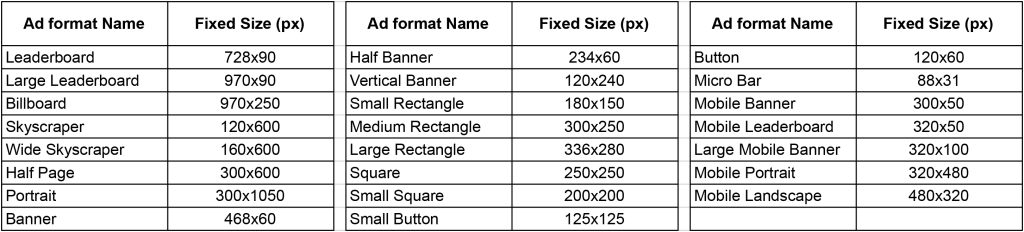
* Standard banner ad formats
The main disadvantage of standard formats is their limited flexibility in today's digital environment. When users actively interact with content on mobile phones, tablets, laptops, and widescreen monitors, if a website or app does not support correct scaling, the banner may display incorrectly or fail to fit on the screen entirely.
This makes it necessary to implement responsive formats and use adaptive banner ads, which we discussed earlier (Responsive Banner Ads, Adaptive Banners). Although creating them requires more complex design and rigorous testing, it is an important step in the evolution of digital advertising.
The file format or technology used for a banner ad determines its quality, interactivity, and compatibility with various platforms. Static images in PNG or JPEG formats are suitable for simple banners, while GIF animation adds dynamics. Modern HTML5 ads allow the creation of interactive and animated banners with high performance, while the MP4 video format is used for impactful advertising solutions.
Choosing the right format affects not only the quality of the banner ad but also its effectiveness, loading speed, and compatibility with different advertising platforms and devices. Understanding the features of each format will help you choose the most effective option for a specific advertising campaign.
JPEG Banner Ads are banner ads in JPEG (Joint Photographic Experts Group) format, which is one of the most common in the digital environment. This format is used for static banners and is well-suited for images with a large number of details and colors.
The main advantage of JPEG banners is their small file size while maintaining high quality. Unlike PNG files, which retain higher quality and support transparency, JPEGs have better compression. Compared to GIF, JPEG images look sharper and do not have a 256-color limit, but the format does not support animation.
Banners in JPEG format are most commonly used for simple advertising campaigns. For example, for branded creatives, promotional campaigns, and ads that do not require animation or interactive elements.

* Banner in JPEG format (download file)
PNG Banner Ads are banner ads in PNG (Portable Network Graphics) format, which features high image quality and support for transparency. This format is often used when it is crucial to preserve graphic clarity, detailing of fine elements, and correct display on various backgrounds.
The main advantage of PNG banners is the ability to use a transparent background, which provides more design flexibility. For example, such banners can integrate harmoniously into a website's design, rather than appearing as a separate rectangular block with a white or colored background.
Unlike JPEG, the PNG format does not use lossy compression, so images remain sharp even after repeated editing. However, this format typically has a larger file size, which can affect page loading speed. Unlike GIF, PNG does not support animation.
PNG is an ideal option for branded creatives, banners with text on complex backgrounds, and cases where a flawless visual appearance without compression artifacts is required.

* Banner in PNG format (download file)
GIF Banner Ads are banner ads in GIF (Graphics Interchange Format) format, which supports animation. Thanks to a sequence of frames playing in a loop, a motion effect is created, making animated images more noticeable compared to static ones.
GIF banners can contain short animated transitions, text changes, or flashing effects that help capture the target audience's attention. Their simplicity and versatility make them a good choice for dynamic advertising without the need to use more complex formats like MP4 or HTML5.
However, GIF also has its limitations. First, the format supports only 256 colors, which can result in a loss of image quality, especially if there are gradients or complex details. Second, the file size can be significant, particularly if the banner contains many frames or high resolution. In addition, GIF animation has limited smoothness, as it usually operates at a lower frame rate compared to HTML5 or MP4.
Nonetheless, there is a Smooth GIF technology that allows improving animation smoothness by using more intermediate frames and reducing sharp changes between them. Thanks to this, a Smooth GIF can look much more attractive and closer to video formats. However, this approach increases the file size, so it should be used with caution to avoid affecting the banner's loading speed.
Banners in GIF format are best suited for advertising campaigns aimed at increasing brand awareness, promo offers, or short messages that can be conveyed through simple animation.

* Banner in GIF format (download file)

* Banner in GIF format with smooth GIF technology (download file)
WebP Banner Ads are banner ads in WebP format, which was developed by Google as a more efficient alternative to JPEG, PNG, and GIF. This format combines the best qualities of other formats: high image quality, support for transparency and animation, all while having a significantly smaller file size.
Compared to JPEG, WebP provides better detail with a smaller file size. Like PNG, this format supports transparency but occupies less space, which positively affects page loading speed. Additionally, WebP can replace GIF because it supports animation while providing smoother transitions between frames and better optimization.
The main disadvantage of WebP is its incomplete support in some older browsers and systems, although today most modern browsers, including Chrome, Safari, Edge, and Firefox, work with this format without issues. It should also be considered that not all ad networks support it, so it is important to check compatibility with a specific ad network before using this format.

* Banner in WebP format (download file)
MP4 Banner Ads are banner ads in MP4 (MPEG-4 Part 14) format, which use video to capture user attention. Unlike static images or animated GIFs, banners in MP4 format can contain full video clips with smooth transitions, effects, and sound, making them one of the most powerful formats for digital advertising.
The video format allows advertisers to use cinematic effects, emotional content, and complex visual stories that are difficult to implement in GIF or HTML5. This is an ideal choice for brands wanting to make a strong impression and increase user engagement.
Unlike GIF, MP4 has no color limitations and supports high frame rates, ensuring a professional look for the advertisement. Also, the size of an MP4 file is usually smaller than that of an HTML5 banner with similar animation because video uses efficient compression.
However, such banners also have their specifics. Since it is video, they may not be supported by all advertising platforms in a standard ad unit. Additionally, video auto-play can sometimes be disabled in browsers or require user interaction.
Banners in MP4 format work great in social networks, video platforms, and specialized ad networks where video can convey the brand's key message in a matter of seconds.
* Banner in MP4 format (download file)
HTML5 Banner Ads are modern-format banner ads that use HTML, CSS, and JavaScript to create dynamic and interactive advertising. Unlike GIF or static images, HTML5 banners can contain complex animation, video, interactive elements, and even adapt to different screen sizes.
HTML5 banners have no color restrictions, unlike GIFs, and are not compressed with a loss of quality, unlike JPEGs. They can also include animated effects with high frame rates, making them much smoother and more professional-looking compared to GIF animation.
This format allows for the creation of more creative and engaging ads that can react to user actions, for example, changing content on hover or containing interactive buttons. This makes it possible to make advertising more attractive and effective.
Such banners are usually stored and uploaded to advertising platforms in a ZIP archive format. This archive contains all the necessary files: HTML code, CSS styles, JavaScript scripts, images, and other media files. It is important that the archive structure complies with the requirements of the specific platform, as an incorrectly organized ZIP file may be rejected by the system.
HTML5 banners are especially effective for campaigns that require responsiveness, complex animation, or interactive elements that increase user engagement.
* HTML5 banner (download file)
AMPHTML Ads are advertisements created using AMP (Accelerated Mobile Pages) technology, which was developed by Google for faster content loading on mobile devices.
The main advantage of AMPHTML banners is their speed. Thanks to a special code structure, they load much faster than HTML5 banners, which is especially important for mobile traffic. This positively affects interaction rates, reduces the likelihood of skipping the ad, and can improve the click-through rate (CTR).
Another benefit is security. All AMPHTML ads run only in a secure environment and do not contain malicious scripts, making them more reliable for advertising platforms and users. In addition, they are designed with responsiveness in mind, allowing them to display correctly on different screens and devices.
However, there are also some limitations. Their use is limited to platforms that support AMP, so they work best in Google Ads and partner networks.
AMPHTML banners are still used and are best suited for campaigns focused on mobile traffic that require the fastest possible display of ad creatives without losing quality and functionality.
* AMPHTML banner (download file)
This is indeed an interesting question concerning the difference between these concepts in the context of digital advertising. Often, the terms "banner format" and "banner type" are used interchangeably, though they actually have different meanings. "Format" usually refers to the technical implementation of the banner (size, file, technology), whereas "type" refers to the banner's style, function, or mechanics. However, even experienced professionals can mix these concepts. Why does this happen?
Here are what we believe to be the main reasons:
The broad meaning of the word "format"
The word "format" itself is quite versatile, and its meaning goes far beyond technical characteristics. In everyday life, we talk about formats of documents, TV shows, training programs—and each time we mean not only their technical side but also the overall structure or presentation method. The same happens with banner advertising.
When people hear "banner format", they intuitively perceive it as any category of banner, without thinking whether it refers to its technical implementation or functional type. For example, an HTML5 banner and an interactive banner might end up in the same list of "formats", although the former relates to technology and the latter to interaction mechanics.
Due to such flexibility of the word "format", it has become a convenient and universal term that replaces "type".
Difference in approaches
Designers and developers usually focus on the technical side of banners: how they are displayed, what files are used, and how the banner works in a browser or mobile app. For them, it is important whether it is HTML5, GIF, MP4, or PNG, so they intuitively use the word "format".
On the other hand, marketers and media buyers are more focused on how the banner affects the audience, what the options for interacting with the user are, and what type of advertising will yield a better result. They more often speak of banner "types": static, animated, interactive, video, etc.
This difference in approaches leads to the same banner being described differently depending on who is talking about it.
Technological changes
With the advent of HTML5, responsive, and interactive banners, the boundary between these concepts has become less distinct. For example, while interactive banners used to be just one of the banner ad types, today they are almost always created in HTML5. This prompts some professionals to call HTML5 not just a format, but something that defines the type of advertising itself.
The same trend is observed with adaptive banners, which change size depending on the user's device. Is this a separate banner type or just a new approach to format?
Habit and widespread use of incorrect terminology
The advertising industry is changing rapidly, and professionals often use terms in a way that is convenient for them, without reflecting on their exact meaning. If most colleagues say "banner format" even when they mean "banner type", this practice spreads quickly. And when major advertising platforms, such as Google Ads or Meta Ads, also use "format" as a universal term in their documentation, this only reinforces the trend.
Ultimately, all this confusion is not critical, but it can affect communication between advertisers, designers, and developers. If one party speaks of a "banner format" meaning GIF or HTML5, while the other thinks of Leaderboard or Skyscraper, it can cause misunderstandings. Therefore, it is important to understand the difference and pay attention not only to the terms but also to the context in which they are used.
When it comes to choosing a banner ad type, there is no one-size-fits-all formula. Every ad campaign has its own goals, audience, and budget, so the right choice depends on a combination of factors. Here are some key tips to help you make the optimal choice:
Before choosing an ad type, it is important to define the ultimate goal of the advertisement. If the primary task is to increase brand awareness, one set of solutions is appropriate (for example, visually appealing static or animated banner ads placed on websites). If you need to drive a specific action, such as a purchase or registration, other types should be chosen.
Knowing your target audience will help you better adapt your advertising. Where do users spend most of their time? What content do they consume? For example, if your target audience is active social media users, it is logical to focus on ad types that work precisely there. At the same time, a banner ad that performs well on social networks will not necessarily be effective on websites or in a mobile app.
When choosing a banner ad type, consider where users will see it and how it will look in that context. For example, Web Banner Ads offer more opportunities for interactive elements, while Email Banner Ads must be lightweight and load quickly.
Some ad networks or platforms support only static images, while others allow the use of HTML5 or even video. Understanding these nuances will help prevent situations where a well-designed banner simply fails moderation or does not display correctly.
Different banner types and formats have varying costs of development and placement. For example, a simple static banner will be cheaper than a complex animated or video banner. If the budget is limited, you should choose a type and format that offers the best balance between cost and effectiveness. However, it is worth remembering that sometimes a more expensive solution can yield better results, especially if the campaign's goal is audience engagement and interaction.
In the end, there is no point in relying solely on assumptions—it is important to test, analyze, and optimize. Run several options, compare click-through rates, conversions, interactions, and adjust your approach based on the data. Look for solutions that are most effective for you. There is no need to select a certain banner ad type simply because it seems cool or someone said that 'everyone is doing it now'. You must consider the campaign goal, audience, platform, and budget.
Once, creating a banner required hours of work in graphic editors, deep knowledge of design, and layout. Designers manually adjusted every element, exported files in the required sizes and formats, and programmers wrote code to make sure everything ran smoothly. Each animation was created separately, adaptation to different platforms required additional hours of work, and the slightest edits meant returning to the initial stages.
But along with the evolution of digital advertising, the tools for creating it have also evolved. Today, multi-purpose platforms like BannerBoo handle most routine tasks in seconds. There is no longer a need to write code or manually configure dozens of banner versions. Everything is built to make the creative creation process as simple and convenient as possible. Thus, even if you don't have design experience, you can get the hang of it quickly.
The platform's features allow you to create static and animated banners, video banners, and even certain types of interactive Rich Media banners. The presence of a vast library of objects, icons, and images that can be used without restrictions significantly speeds up work, as there is no need to look for additional elements on third-party resources.
Another nice bonus is the ready-made banner templates. They are created by professional designers, so they look stylish and effective. Instead of spending hours developing a layout from scratch, you only need to add your own logo, change the text or colors, and the banner is ready.
What's more, modern platforms offer innovative tools for banner creation, including an AI banner generator. Now, to get a professional design, you only need to enter a few keywords describing your advertising campaign. The artificial intelligence will automatically generate various banner options, which you can fully edit if needed.
And when everything is ready, the banner can be exported in all popular formats (JPEG, PNG, GIF, HTML5, MP4) and used immediately.
If you need to quickly create a banner, multi-purpose platforms like BannerBoo are the best solution. They combine convenience, automation, and a professional approach to design, allowing you to get an excellent result even without experience in ad creation.
AI-generated Banner Ads
AI-generated Banner Ads (banner ads created using artificial intelligence) represent one of the newest directions in the development of digital advertising. While just a few years ago every banner design had to be created manually, today a significant part of the work is handled by generative artificial intelligence.
Such banners are created based on a text prompt. It is enough to specify the theme of the ad campaign, the product, design style, or desired color palette, after which the AI automatically generates several ready-made design options. Modern tools can also suggest headlines, ad copy, call-to-action buttons, select illustrations, and even adapt the banner to different ad formats.
One of the greatest advantages of AI-generated Banner Ads is speed. While traditional creative development can take several hours or even days, artificial intelligence can create dozens of options in a matter of minutes. This is particularly useful for marketing teams that regularly launch new campaigns or conduct large-scale A/B testing.
Another important advantage is the ability to quickly personalize ads. AI can create separate banner variations for different audiences, languages, countries, or seasonal campaigns without needing to completely redesign from scratch. This significantly increases ad relevance and cuts the preparation time for new creatives.
AI banners are already actively used in e-commerce, SaaS, real estate, finance, education, and local business. They are excellent for companies that regularly produce large volumes of promotional materials and seek to automate the creative production process.
Regardless of which banner ad type and format you choose and which tools you use, there are several important aspects to consider when creating promotional content. These are certain mistakes, and avoiding them can significantly improve the performance of your banner ad campaigns.
To form a unified visual identity and build trust, the banner must match the brand's visual identity: colors, fonts, logo, and overall communication style. If the advertisement is not recognized as part of the brand, it loses its recall effect, and the company looks inconsistent.
A banner is not the place for long explanations or complex arguments. If it is overloaded with text or contains too many details, the user simply will not perceive it as a whole and will likely ignore it. An ideal banner has a maximum of three key points that immediately convey the core message. Everything extra distracts and reduces the probability of a click.
An unbalanced composition, poorly selected colors, hard-to-read fonts, or too small text make the banner unsuitable for interaction. If it looks cheap or unprofessional, it automatically ruins the perception of the brand. A separate issue is using random or incompatible colors that do not harmonize. Instead of an appealing visual presentation, you get a chaotic image that repels the user.
If an ad is shown to a non-target audience, it simply wastes the budget. For example, if a banner with a promotion on men's suits is shown to teenagers or women who have never searched for similar products, the chance of getting a conversion is minimal. To make ads work effectively, you must clearly define your target audience, analyze campaign results, and regularly adjust settings.
A banner can be bright and eye-catching, but if the user does not understand what they are expected to do next, the effectiveness of such an ad will be minimal. The CTA should be high-contrast and placed in a logical spot, with clear and simple phrases like "Learn more", "Buy now", or "Try for free" directing the user in the right direction.
Flashing banners, abrupt animations, neon colors, or ads that cover content and force the user to look for ways to dismiss them only cause irritation. Instead of attracting attention, such banners make people look for the "Block Ads" button.
Banners with text like "You won a new iPhone!" or buttons that mimic interface elements (for example, a fake "Close" or "Download") may increase the number of clicks, but they certainly do not build trust in the brand. When a user realizes they have been deceived, they either immediately close the page or remember the company as untrustworthy.
Digital advertising continues to evolve rapidly, and along with it, the requirements for banner ads are changing. While the primary focus used to be on the number of impressions and clicks, today advertisers are paying more and more attention to personalization, user engagement, and automated creative production.
The most promising formats in 2026 are considered to be:
At the same time, classic static and animated banners remain relevant for campaigns aimed at broad reach, remarketing, and quick audience updates. The best results are typically achieved by combining different banner types tailored to the specific goals of the advertising campaign.
Banner advertising has come a long way—from simple static images to interactive, responsive, and dynamic ad types. Today, advertisers have a multitude of options, each with its unique advantages, characteristics, and use cases.
But the market does not stand still, and we are constantly looking for new ways to capture user attention, increase campaign effectiveness, and improve the ad interaction experience. Thanks to technological shifts, new banner ad types are emerging, and the introduction of artificial intelligence, automation, and data analysis allow for more precise ad configurations, making them highly relevant to the target audience.
Despite all challenges, banner advertising remains an integral part of digital marketing. It continues to evolve, offering advertisers greater flexibility and opportunities. The key is not to remain within outdated frameworks but to experiment with new formats, test strategies, and adapt to the changing digital landscape.