Social media demographics in 2026 are no longer just about age or gender of the audience. They define how, where, and for what purpose users interact with content. People are not limited to one platform: most actively use several social networks simultaneously, switching between them depending on the task (from entertainment to searching for information and making purchasing decisions). That is why understanding the audience of each platform becomes critically important. We have collected current social media demographics for 2026, divided them by platforms, audience types, and content, to help you choose the right channels and build an effective marketing strategy.
Introduction
Overview of social media statistics (2026)
Social media demographics by platforms (2026)
Facebook Demographics
Instagram Demographics
TikTok Demographics
YouTube Demographics
LinkedIn Demographics
X (Twitter) Demographics
Snapchat Demographics
What has changed? 2026 vs 2025
How to use social media demographics data in 2026?
Conclusion
Social media demographics in 2026 encompass more than just age and gender. It is one of the key factors for effective marketing, determining exactly where your target audience is, how they consume content, and what decisions they make on different platforms. In an environment where competition for user attention is constantly growing, understanding demographics becomes not an advantage, but a necessity.
The main change of recent years is audience fragmentation. Modern users are not limited to one social network: according to DataReportal, the average internet user uses about 6–7 social platforms per month. At the same time, the scale of social networks continues to grow. According to DataReportal, there are over 5.6 billion social media users worldwide, which is approximately 69% of the planet's population.
This means that social media has long ceased to be just a communication channel – today it is a full-fledged ecosystem of interaction with a brand. Additionally, user behavior is also changing. In particular, younger audiences are increasingly using social media as an alternative to search engines: about 40% of Generation Z representatives search for information through social platforms, not traditional search.
In this article, we have collected current data on social media demographics in 2026. This information is necessary if you want to understand who your audience is, what content works best, and how to use these insights to build an effective marketing strategy.
As of 2026, social media has reached an unprecedented scale and impact on user behavior. According to DataReportal, the total number of social media users is approximately 5.6–5.7 billion people. This means that social platforms already cover most of humanity and have actually become the basic digital environment for communication, content consumption, and brand interaction.
At the same time, even more conservative estimates confirm the scale: over 60% of the world's population actively uses social media.
The most massive and popular platforms remain:
They have the widest global penetration and cover various age groups.
Separately, it is worth paying attention to the change in audience behavior: users are increasingly using social networks to search for information or a place to make a purchase. This changes the role: social networks are becoming a place to gain knowledge about a product and make purchasing decisions.
Social media in 2026 is no longer just a separate marketing channel, but a full-fledged ecosystem where users discover brands, research products, and readily buy from companies.

So, the first thing to say before the statistics: do not look at social networks as interchangeable channels. Each platform has a clearly formed demographic profile and, more importantly, a different context of use: people come there with different intentions – from scrolling when there is free time, to searching, learning, or making a purchasing decision. That is why even the same audience behaves differently on different platforms.
Audience:
What this means:
What to publish?
Audience:
What this means:
What to publish?
Audience:
What this means:
What to publish?
Audience:
What this means:
What to publish?
Audience:
What this means:
What to publish?
Audience:
What this means:
What to publish?
Audience:
What this means:
What to publish:
So, each social network in 2026 has its own demographic profile, content consumption style, and role in interacting with the brand. Facebook works for mass appeal and trust, Instagram for visuals and emotions, TikTok for discovering new things, YouTube for in-depth product research, LinkedIn for expertise, and X and Snapchat for quick communication and relevance. That is why an effective strategy is built not around one platform, but around the right combination of channels, formats, and content for a specific audience.
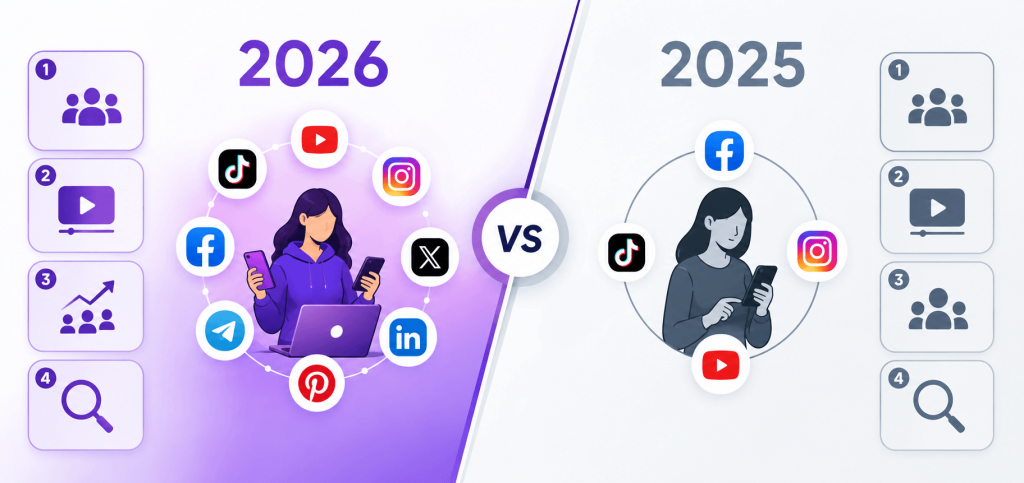
Despite the fact that the key platforms remain the same, in 2026 the very logic of using social networks has changed. Users began to spend more time simultaneously on several networks, which means they are less loyal to one particular platform and demand much more from content.
According to DataReportal, a user uses up to 6–7 platforms per month. This was already a certain trend in 2025, and in 2026 it became a standard. Users distribute different tasks among platforms: in TikTok they look for new experiences, on YouTube they explore its use, and on Instagram – purchasing opportunities.
That is why the thesis "key platform – main marketing channel" no longer works, and marketers will build holistic ecosystems of communication channels with the audience.
TikTok sets the standard for content consumption, which Instagram (Reels) and YouTube (Shorts) have picked up. Short videos are the fastest growing content format. Make them so that the client understands the full value in 3 seconds, and you will have a chance that the video will be watched to the end.
Facebook is gradually shifting its audience towards older age groups, but remains the largest platform in the world. Your brand's presence in Meta continues to be a priority.
Younger audiences, especially Gen Z, are increasingly using social media to search for information. About 40-41% of users prefer platforms over traditional search. This means: it is important to optimize content for search (keywords, description, structure), because SEO is no longer limited exclusively to Google.
In 2026, social networks are no longer a set of separate platforms, but a complex ecosystem where each channel plays its role in the funnel: from search to conversion. Brands need to adapt to this reality, otherwise they risk simply losing contact with their audience.
Understanding social media demographics alone means nothing if it is not put into practice. In 2026, brands that not only know their audience but also build platforms, content, and communication for them will win.
Your task is not to be everywhere, but to be where your target audience (ICP) is.
How to start working?
Remember: the same person is on different platforms, but with different goals.
You need to work at every stage of the sales funnel:
How to start working?
Do not duplicate the same content, better adapt it to the role of the platform. This way you will build a logical user path between channels.
One of the most common mistakes is the same communication style everywhere. Each platform "sounds" differently:
How to start working?
Change the style, not just the format. And be sure to test different approaches within the same platform.
Different age groups consume content differently – and this directly affects effectiveness.
Gen Z prefers:
As for millennials, here are important:
Older audience (Gen X, Boomers) values:
How to start working?
So, demographics are not a limitation, but a guide. In 2026, effective marketing combines the right platform, relevant content, and appropriate communication style for a specific audience.
However, even the most accurate demographic data does not guarantee results. They are only a starting point, not a ready-made strategy. Real effectiveness depends on how algorithms work, how your audience behaves, and how quickly you can adapt to changes.
Remember: people of the same age can consume content completely differently. Someone watches short videos, someone reads long posts, someone seeks expertise. It is interests and behavioral patterns, not just demographics, that determine effectiveness.
In 2026, social networks ceased to be just platforms for publishing content. Today, it is a complex system of interaction between a brand and its audience, where each platform plays a separate role: from getting to know the company to building trust and making a purchasing decision.
Social media demographics help understand not only who your audience is, but also how exactly they consume content, what formats they choose, and what they expect from brand communication. That is why successful marketing is no longer built on the principle of "being everywhere." It is much more important to choose the right channels, adapt the Tone of Voice, and create content for the behavior of a specific audience.
At the same time, multi-platforming remains a key trend: users easily switch between TikTok, Instagram, YouTube, Facebook, or LinkedIn depending on their needs. This means that brands need to think not in terms of individual social networks, but a holistic ecosystem of communication.
And most importantly – demographic data is not a ready-made formula for success. It only sets the direction. Real results appear when a business constantly analyzes its audience's behavior, tests new formats, and quickly adapts to changes in the digital environment. It is this flexibility that will become the main advantage of brands in social media in the coming years.